Project Overview
Helping people find their style
KraftMaid offers a wide range of cabinetry and design options, but for many homeowners, knowing what they like is easier than knowing how to describe it.
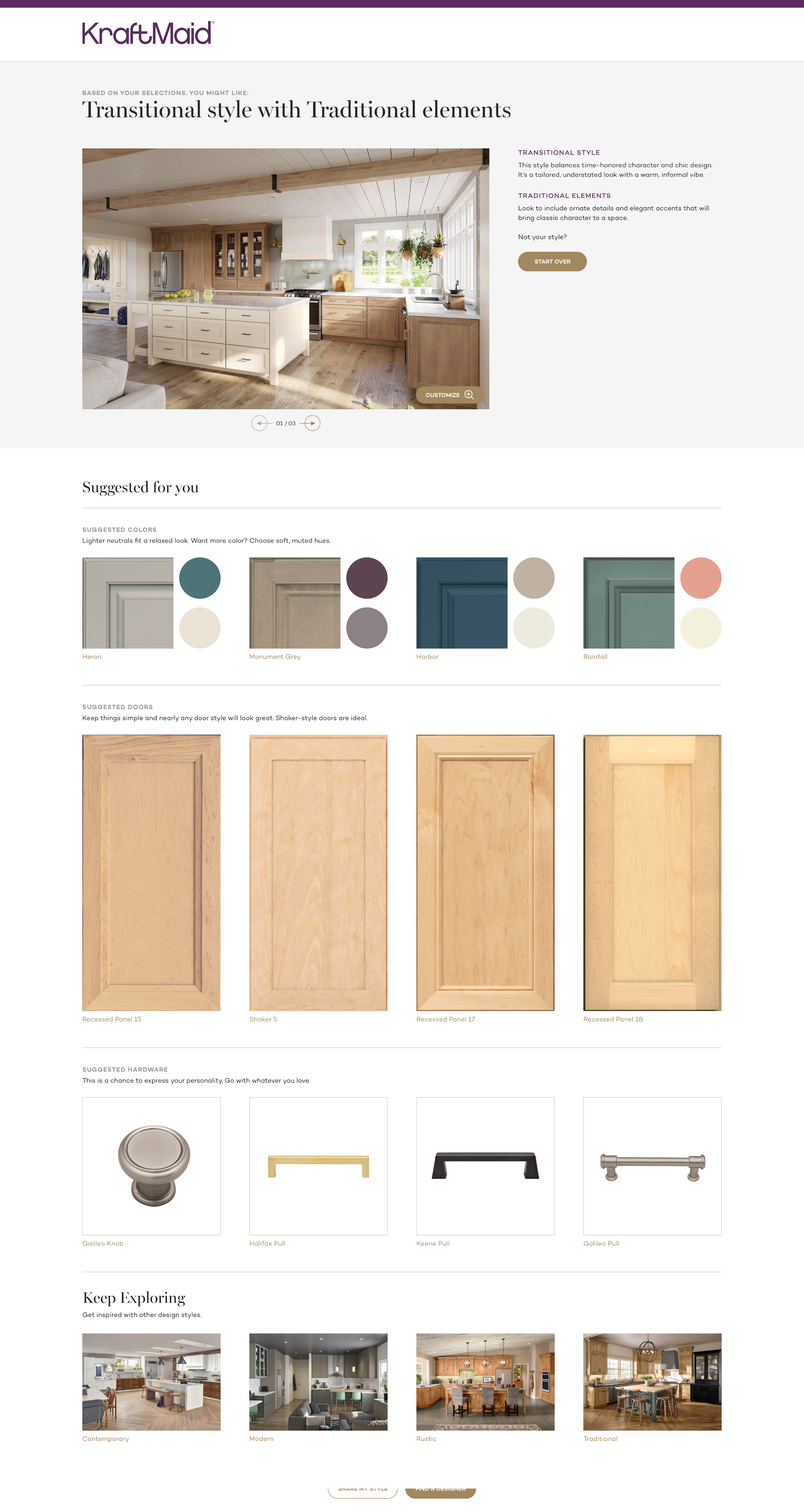
I worked with a team to explore a more engaging way to help users identify their personal design style while introducing them to KraftMaid's products and design services. The result was an interactive style quiz that used visual preferences to create a more personalized experience.
User Testing
Understanding how people choose
The research process began with preparing the usability testing script, test pages, and prototypes to evaluate two potential directions for the KraftMaid Style Tool. I helped structure the sessions around key research questions, then conducted moderated interviews with users to understand their experiences, expectations, and reactions as they navigated each concept.
Following testing, I analyzed user feedback and behavioral observations to identify patterns, compare the two concepts, and determine the strongest direction forward. I translated those findings into design recommendations and then executed the final rounds of edits to refine the selected experience based on what we learned from users.
Usability research overview
01
Defined research goals around how homeowners identify design styles, evaluate tool concepts, and determine next steps.
02
Conducted moderated remote usability sessions using interviews, observation, think-aloud feedback, and task-based evaluation.
03
Tested two style-selection concepts to compare how users browsed and selected imagery.
04
Evaluated key usability factors, including comprehension, content, navigation, and customization.
05
Compared user preferences through qualitative feedback and 1–5 ratings for ease of use and usefulness.
06
Synthesized findings into design opportunities and recommendations for the final experience.
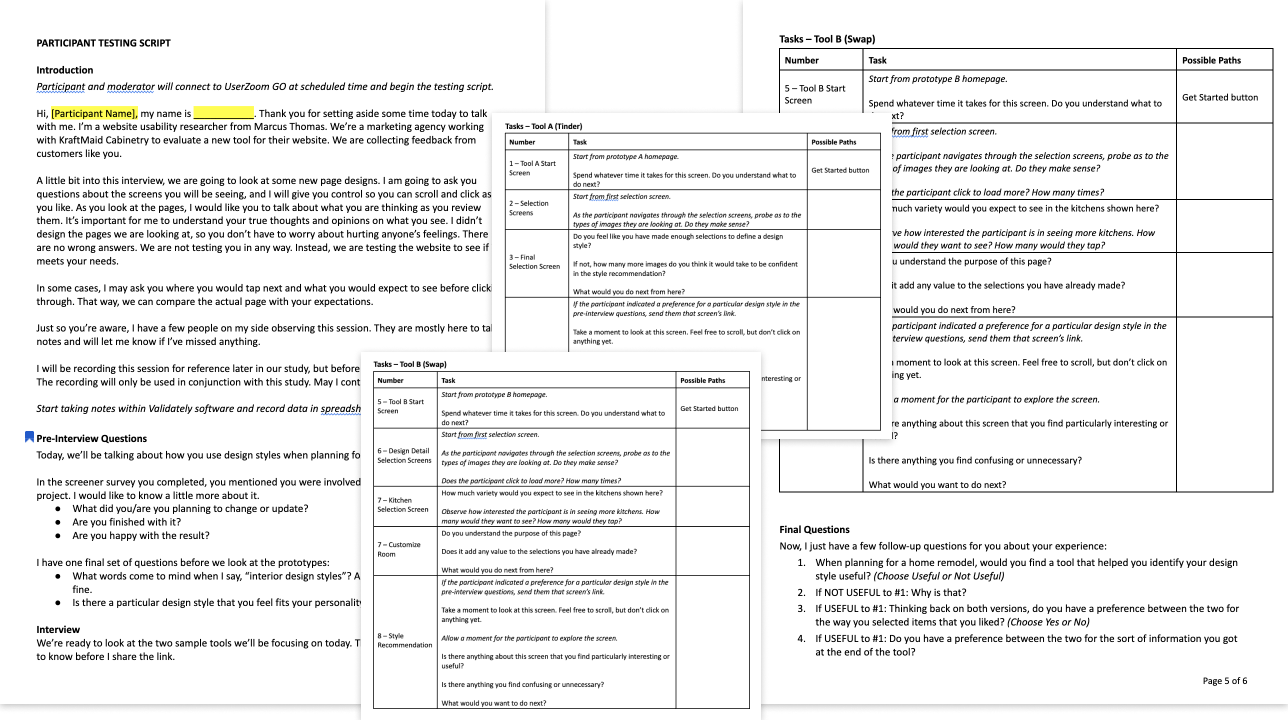
We developed a comprehensive testing script and set of questions for each design direction, recruited and retained participants, and conducted moderated virtual testing through Optimal Workshop, following established usability testing guidelines throughout the process.
Prototyping
Testing two directions before committing
Rather than choosing a direction on internal preference alone, I led development of two distinct prototypes and brought both into user interviews — watching how participants navigated, interpreted questions, and responded to visual choices.
User Testing
Letting user behavior shape the experience
After the sessions, we compiled and analyzed the feedback to identify patterns in how participants interacted with the concepts. Rather than treating individual comments as isolated feedback, we looked for recurring behaviors, points of confusion, and moments where one approach consistently performed better than the other.
Those findings helped us determine which elements to carry forward and where the experience needed to be simplified or rethought.
Findings overview
01
Visual choices felt more intuitive than terminology. Users could react to imagery more naturally than they could define their style using design vocabulary.
02
The experience needed to stay visually focused. Too much information competing with the imagery made the decision-making process harder.
03
Recommendations needed to feel personal. Users responded better when the experience felt like it was learning about their preferences rather than simply assigning them a style.
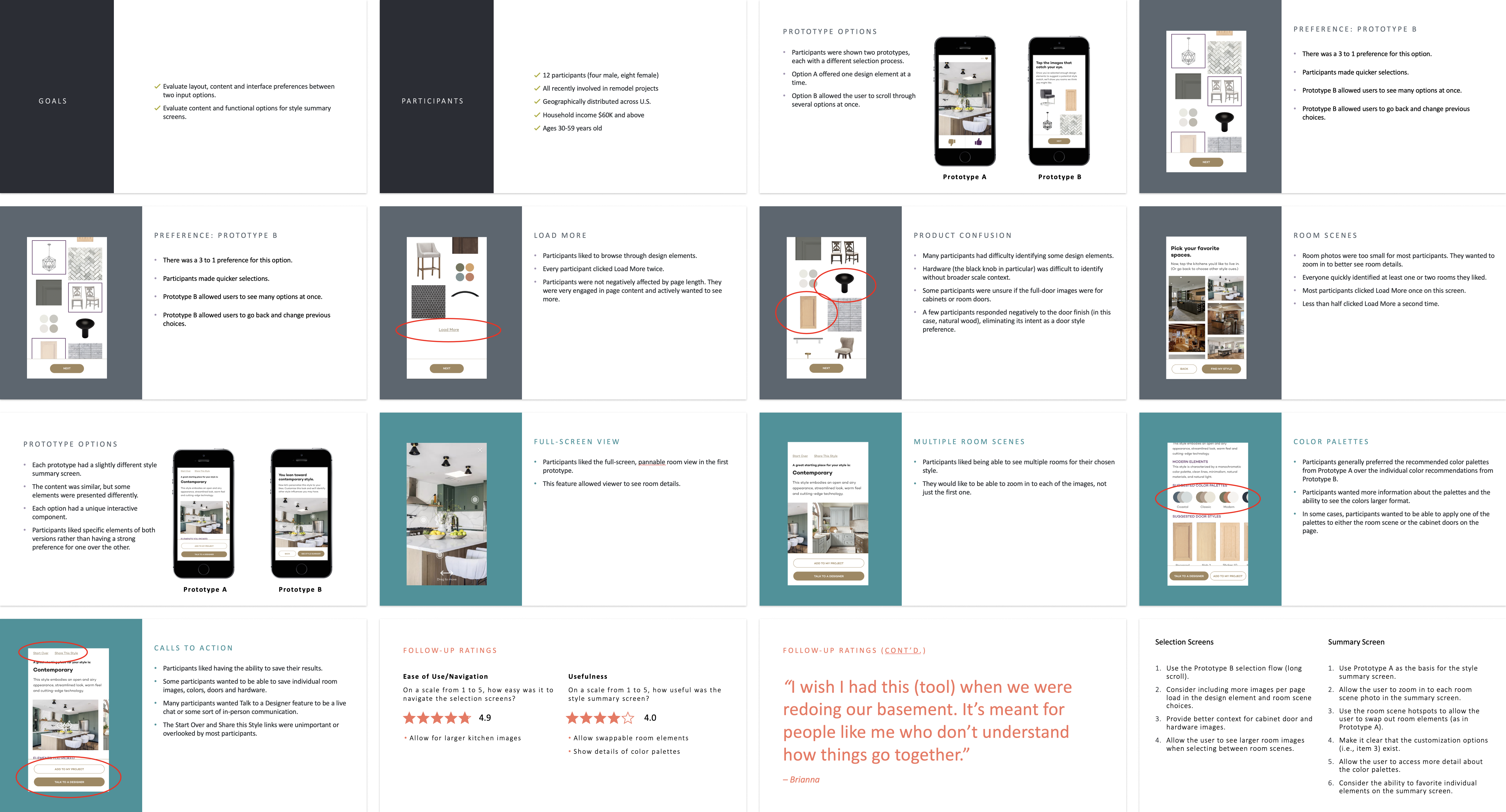
We synthesized the feedback into measurable insights, identifying meaningful quotes, comments, and points of frustration. Success was evaluated through task completion rates and participant ratings of how easy each task was to complete.
Strategy Insight
Connecting personal style to product discovery
The tool had to be useful beyond the quiz itself.The experience wasn't designed simply to tell users whether they were "modern" or "traditional." It created an opportunity to connect that personal preference to something users could actually act on. Style recommendations could introduce users to relevant KraftMaid products and encourage them to continue exploring their options or connect with a design professional.
The result was a more natural relationship between personal discovery and product discovery, giving users a reason to engage with the brand before they're ready to make a purchasing decision.
Outcome
A tool built to drive engagement
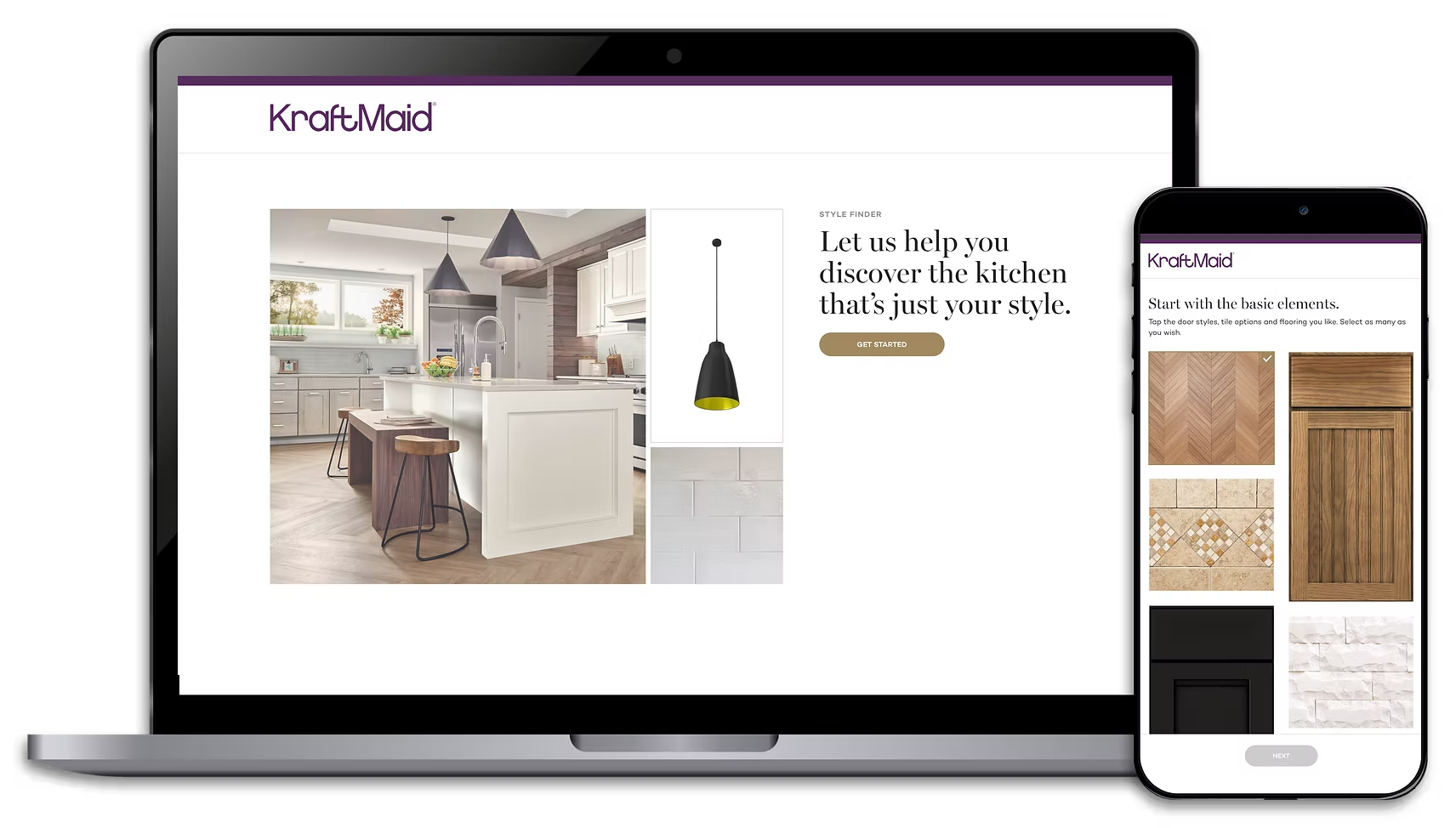
The experience turned style discovery into sustained interaction.Since launch, the tool generated 1,945,200 sessions and more than 9.3 million views, with an engagement rate of nearly 63% — well above the 40% industry benchmark.
The experience also generated 219,600 form submissions, showing that users weren't simply browsing the tool but continuing through the experience and taking meaningful actions.